{{ 'fb_in_app_browser_popup.desc' | translate }} {{ 'fb_in_app_browser_popup.copy_link' | translate }}
{{ 'in_app_browser_popup.desc' | translate }}
{{ childProduct.title_translations | translateModel }}
{{ getChildVariationShorthand(childProduct.child_variation) }}
{{ getSelectedItemDetail(selectedChildProduct, item).childProductName }} x {{ selectedChildProduct.quantity || 1 }}
{{ getSelectedItemDetail(selectedChildProduct, item).childVariationName }}
In recent years, more and more people have embraced hair coloring as a way to express their individuality. However, the dryness, breakage, and frizz that often follow have made many first-timers hesitant to give it a try. In this article, we’ve invited Yaya, a hairstylist from Una Salon in Tainan, to share how she diagnoses clients’ hair condition and reveal her personal tips for at-home hair care.
Catalogue
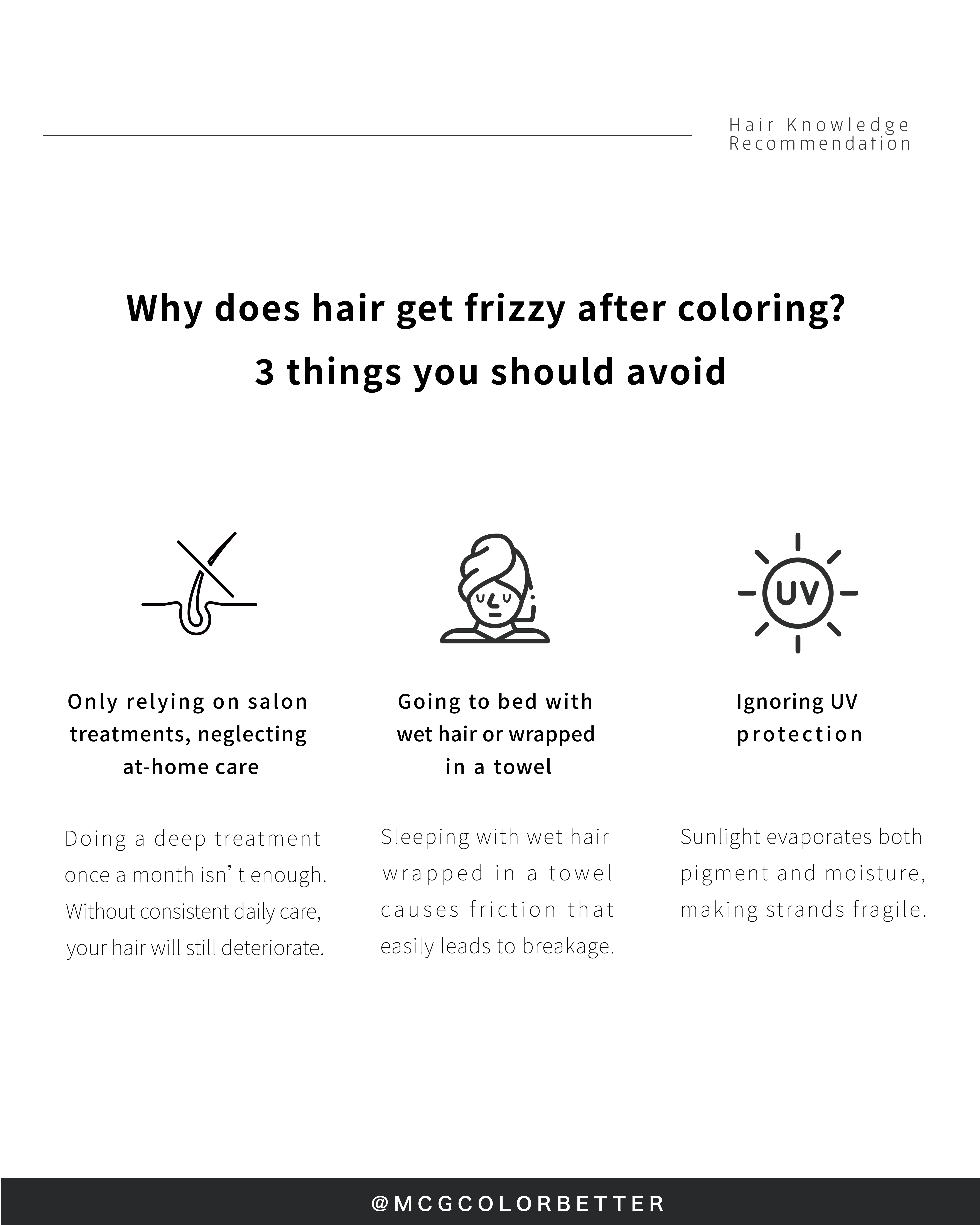
Why does hair get frizzy after coloring? 3 things you should avoid
Many people notice their hair becoming frizzy, dry, or noticeably weaker after coloring, and they quickly assume, “It’s normal for hair to get frizzy after dyeing.” But the issue isn’t just about those one or two hours in the salon chair. As Yaya explains, “The chemicals do cause some damage, but what truly determines the fate of your hair is the aftercare and your daily habits.”
Superficial care—nutrients can’t penetrate
Many people rely solely on in-salon deep treatments and neglect at-home hair care. But that’s far from enough—after all, you usually only get a deep treatment once a month. Without proper maintenance in between, your hair will inevitably deteriorate over time.
Going to bed with wet hair or wrapped in a towel
Leaving hair wet after washing and lying down with it wrapped in a towel is a big no-no. Yaya explains that when hair stays damp and constantly rubs against the towel, it becomes highly susceptible to damage. For bleached hair especially, this habit can easily lead to breakage.
Ignoring UV protection
Extended sun exposure causes UV rays to evaporate both pigment and moisture from the hair. Heat can also denature the proteins inside the strands, making them weak and less elastic. As a result, hair loses hydration more quickly. This effect is even more pronounced on colored or permed hair, where lifted cuticles increase the surface area exposed to UV rays, leading to more severe damage compared to healthy hair.
How do stylists assess the risks of hair coloring?
Yaya’s hair coloring works
A professional and experienced hairstylist always follows a set of risk-assessment steps before coloring a client’s hair. This process ensures that hair in poor condition isn’t put through coloring, which could otherwise not only fail to achieve the desired result but also further worsen the hair’s health.
Hair that has undergone multiple rounds of coloring or perming often shows dryness, frizz, or even breakage. Yaya explains that extremely damaged hair—unsuitable for further coloring—can usually be identified at a glance. In such cases, she advises clients to first use the full MEM Honey Moisture Care series at home for about a month to restore their hair’s condition before attempting another color service.
Of course, there are always clients eager for a transformation right away. For them, Yaya conducts a “reality check.” She takes them to the shampoo station, washes their hair once with a deep-cleansing shampoo, and then lets them feel their strands’ true condition. When clients with severely compromised hair see and touch the straw-like texture, they quickly realize the importance of restoring their hair first—and most decide to wait before coloring.
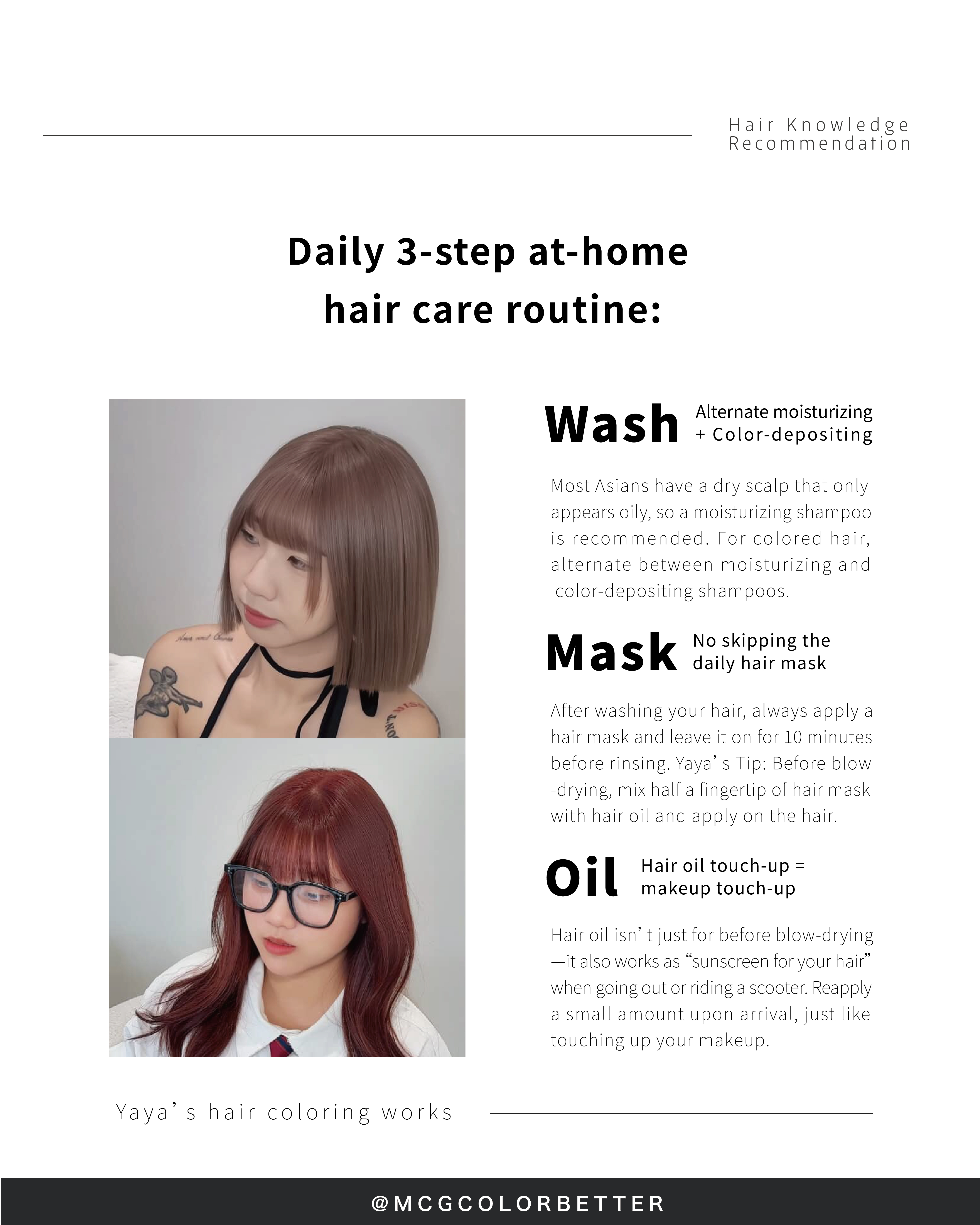
Daily 3-step at-home hair care routine after coloring
If you want your hair to stay gorgeous not just on salon day but every day afterward, your at-home wash and care routine is key. Yaya’s top recommendation is the MEM Empower series with its simple “Daily 3-Step Routine.” She emphasizes that as long as you consistently wash → mask → oil every day, you can elevate your hair quality to a full 100% of beauty!
Wash: Pair moisturizing shampoo with color-depositing shampoo
Yaya points out that many Asians have what she calls “pseudo-oily scalp”—dry, flaky skin that appears oily. That’s why she recommends a moisturizing shampoo. For those with colored hair, hydration is just as important as color retention. After coloring, you can alternate between a moisturizing shampoo and a color-depositing shampoo—use MEM Empower Shampoo today, then a color-depositing shampoo tomorrow. However, Yaya adds that if, after a month of using a moisturizing shampoo, your scalp still feels oily, it’s time to introduce a deep-cleansing shampoo.
Mask: No skipping the daily hair mask
Yaya firmly believes in the rule: “If you wash your hair, you must use a mask.” The standard routine is to apply a hair mask after washing, leave it on for 10 minutes, and then rinse. But Yaya has also discovered her own little trick: “Before blow-drying, instead of using only hair oil, apply half a fingertip of MEM Empower Hair Mask. Mixing mask with oil helps the nutrients spread more evenly along the strands.”
Oil: Your on-the-go hair shield
Hair oil is the most basic essential for hair care, and even those who don’t like complex routines usually have it. Most people, however, only apply it before blow-drying. Yaya stresses that it’s also perfect for going out, especially for scooter riders: “Think of hair oil as sunscreen for your hair. You can reapply it once you arrive at your destination—just like touching up your makeup.”
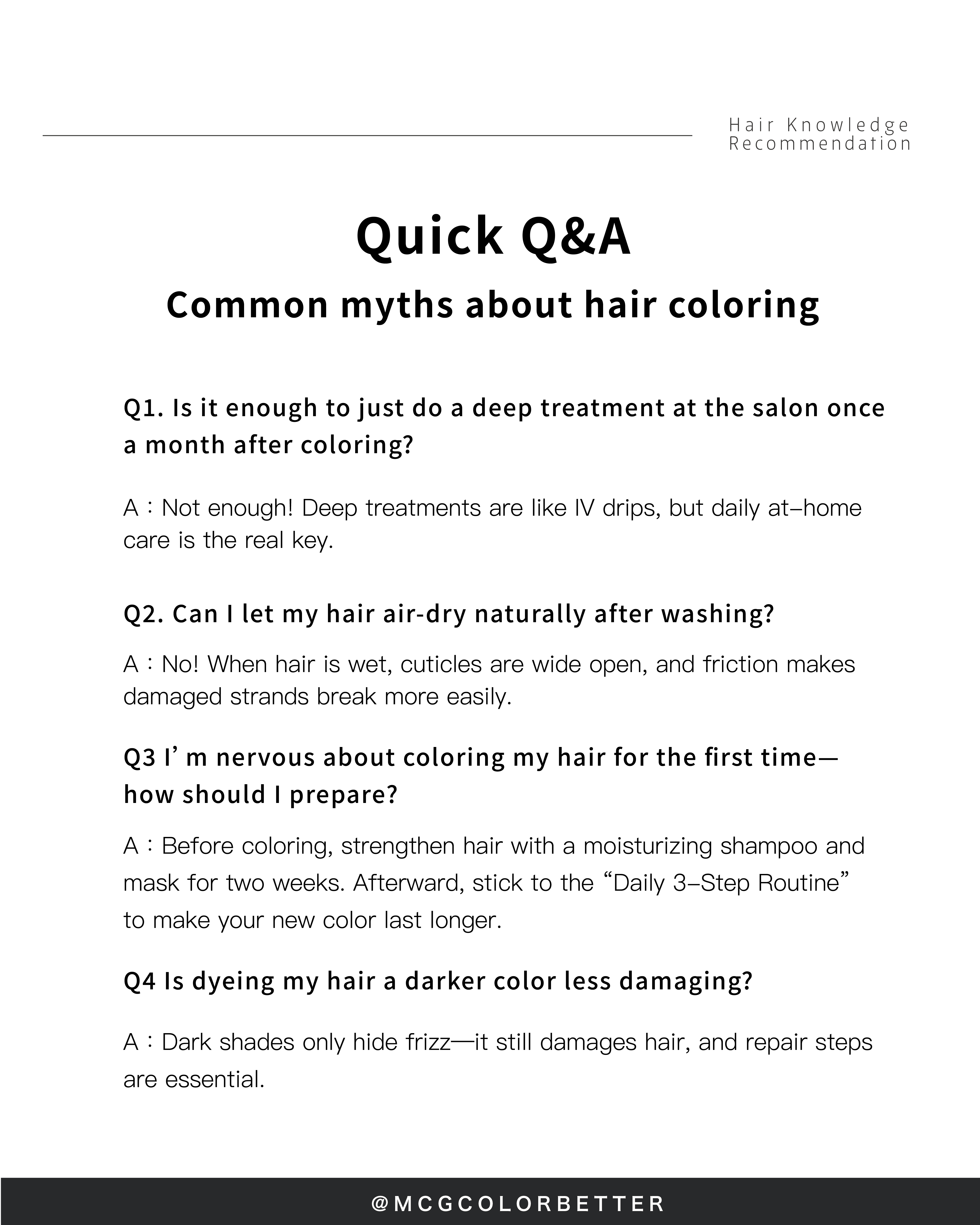
Quick Q&A: Common myths about hair coloring
Q1. Is it enough to just do a deep treatment at the salon once a month after coloring?
A: Salon treatments are like IV drips at the hospital, while at-home care is your daily diet. If you want your hair to stay beautiful long-term, consistent home care is what truly makes the difference.
Q2. Can I let my hair air-dry naturally after washing?
A: Absolutely not! When hair is wet, the cuticles are fully open. On already damaged hair, even slight friction can easily cause breakage.
Q3. I’m nervous about coloring my hair for the first time—how should I prepare?
A: Start by using a moisturizing shampoo and mask for two weeks to strengthen the cuticles. After coloring, follow Yaya’s “Daily 3-Step Routine” to maintain and protect your new shade with confidence.
Q4. Is dyeing my hair a darker color less damaging?
A: Yaya reminds us: “Dark colors only make frizz less visible—it doesn’t mean there’s no damage.” In reality, any exposure to chemicals alters the hair’s structure. Dark shades may use shine to mask damage, but the necessary repair steps should never be skipped.
Recommended stylist in Tainan: Yaya from Una Salon
Yaya’s perming works
Since her school days, Yaya has always dreamed of becoming a hairstylist. Although her family didn’t allow her to pursue a beauty and hairdressing program in high school, those three years of waiting only strengthened her realization: “This is what I truly want to do.” Even when doubts arose about whether she was “cut out” for the profession, she reminded herself, “It’s not that I can’t do it—I just haven’t learned it yet.” With persistence, she kept practicing on models, never giving up, and eventually developed her own system and style.
Yaya specializes in creating layered perms and natural-looking color for women. Pricing starts at $1799 for basic coloring, $2550 for perming, and $500 for haircuts. Clients who book a treatment immediately can also enjoy 25% off their next hair care session. If you’ve been hesitant to try coloring because you’re worried about damaging your hair, click below to connect with Yaya and discover a stylist who truly cares for both your look and your hair’s health!
Tainan hairstylist information
Una Salon (Chengda Branch) – Yaya
Instagram: @yaya_una_
Business Hours: 11:00–20:00
Reservation Line: 06-200-6700
Address: 2F–3F, No. 171, Section 2, Changrong Rd., East District, Tainan City
Further Reading: